

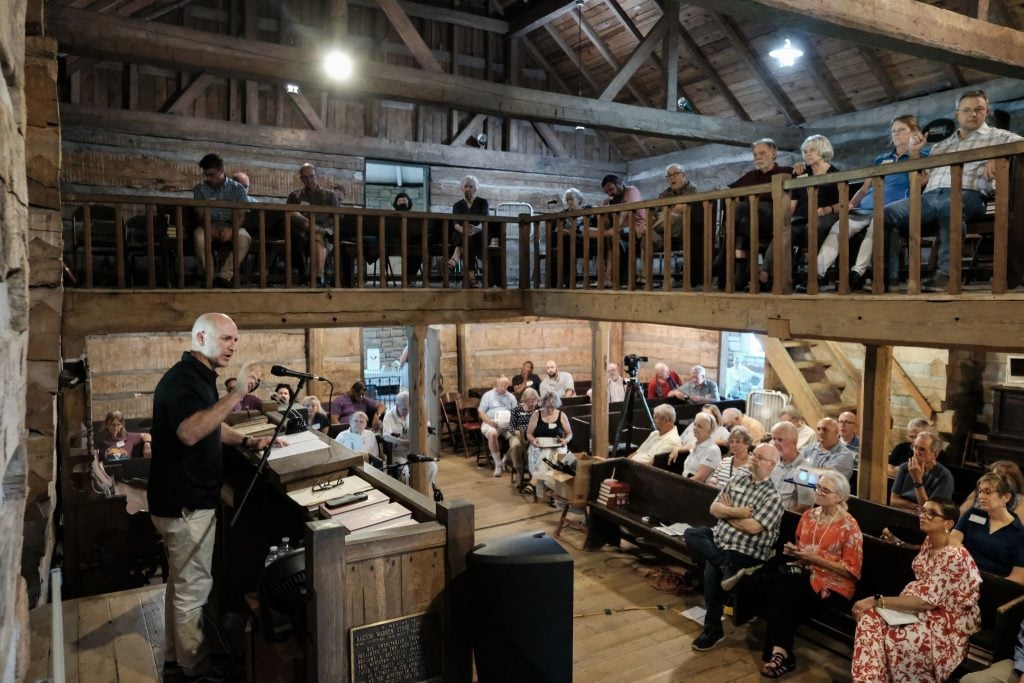
225 years ago, a revival gave birth to a movement
BOURBON COUNTY, KY. — By the thousands, the believers came —…

|
Getting your Trinity Audio player ready...
|
“A Wild Democracy: The Struggle for the Soul of Churches of Christ, 1889–1939” is the first of three volumes on the history of Churches of Christ in the 20th century, compiled by Lipscomb University Bible dean Leonard Allen and retired Lipscomb theology professor John Mark Hicks.
By 1906, three distinct groups had emerged from the Restoration Movement: the Disciples of Christ, the Christian Churches and the Churches of Christ.
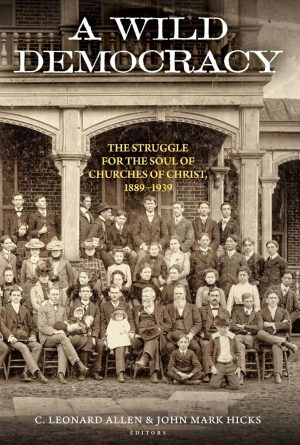
C. Leonard Allen and John Mark Hicks. “A Wild Democracy: The Struggle for the Soul of Churches of Christ, 1889–1939.” Abilene Christian University Press. 2026. 192 pages. $19.99.
“A Wild Democracy” traces the early history of the last of these through 10 essays by eight authors on figures and events that shaped the movement.
Most chapters document disagreements among Churches of Christ. The term “wild democracy,” borrowed from the late historian and preacher David Edwin Harrell Jr., captures the difficulty of negotiating a common identity.
Hicks, in an essay of the 2009 volume “And the Word Became Flesh,” previously suggested that three theological trajectories characterized Churches of Christ in the early 20th century, roughly associated with Indiana, Tennessee and Texas.
Leaders in each tradition adopted different positions on some of the most contentious doctrinal questions of the day, including premillennialism, the personal indwelling of the Holy Spirit and professional ministry.
“A Wild Democracy” is divided into three sections. “The Great Separation” examines the division between Churches of Christ and the Disciples of Christ.
Related: 225 years ago, a revival gave birth to a movement
Daniel Sommer’s 1889 “Address and Declaration” serves as a point of departure, while subsequent chapters consider David Lipscomb; African American leaders Preston Taylor, S.W. Womack and Marshall Keeble; and T.B. Larimore.
Part Two, “A Wild Democracy,” examines further fragmentation within the movement.
The Tennessee tradition embraced miraculous divine intervention, the personal indwelling of the Spirit and a millennial kingdom followed by a renovated earth.
The Indiana tradition favored noninstitutionalism and generally opposed Bible colleges and professional ministers.
The Texas tradition advocated a “Word-only” view of the Spirit, opposed the miraculous and emphasized rigorous obedience to positive commands of Scripture.
Part Three, “A New Identity,” describes the triumph of the more conservative Texas tradition, which shaped the identity of Churches of Christ for much of the 20th century.
“Allen and Hicks are to be commended for editing a splendid and illuminating volume. Readers interested in the history of Churches of Christ will eagerly anticipate the next installment in the series.”
R.L. Whiteside’s influence through the “Sound Doctrine” volumes, produced with C.R. Nichol, and N.B. Hardeman’s “Tabernacle Sermons” disseminated the movement’s emerging consensus. Meanwhile, during the 1930s, the Gospel Advocate became the voice of the Texas tradition in Tennessee.
The volume concludes with excerpts from the figures who shaped the early history of Churches of Christ. Allen and Hicks are to be commended for editing a splendid and illuminating volume. Readers interested in the history of Churches of Christ will eagerly anticipate the next installment in the series.
JUSTIN M. ROGERS is Billy R. Smith Dean and Professor of Bible and Judaic Studies at Freed-Hardeman University in Henderson, Tenn.
As an Amazon Associate, we earn money from qualifying purchases made through the links on this page.
BOURBON COUNTY, KY. — By the thousands, the believers came —…

ATLANTA — Hundreds of Christians came to Atlanta seeking true…

MONTGOMERY, ALA. — Sectarian label or divine ownership? What does…

For many people, history is boring, or there is no…
‘You think you’re the only ones going to heaven.” That’s…

Conservative mainstream. Moderate mainstream. Non-institutional. Non-Sunday school. Progressive. Instrumental. One…
Your donation helps us not only keep our quality of journalism high, but helps us continue to reach more people in the Churches of Christ community.
