

The ties that bind universities to Churches of Christ
From Florida College in Temple Terrace, Fla., to Pepperdine University…

|
Getting your Trinity Audio player ready...
|
NASHVILLE, TENN. — The Crieve Hall Church of Christ meets 4 miles from Lipscomb University. Even in Nashville’s notorious traffic, the drive takes less than 15 minutes.
The distance between the two, though, seems much greater.
@christianchronicle NASHVILLE, TENN. — Jesse Eaton of the Stantonville Church of Christ in Tennessee leads “Soldiers of Christ, Arise!” during the first night of the annual Connect Conference hosted by the Crieve Hall Church of Christ. More than 1,200 church members representing hundreds of congregations participate in the conference. #churchofchrist #crievehall #connectconference ♬ original sound – The Christian Chronicle
In a fellowship that eschews manmade creeds and seeks to follow God’s Word alone, Crieve Hall represents a core of beliefs often labeled “conservative.” A statement of faith on the church’s website touts a commitment to “correctly handling His Word without adding to or taking from it.”
Worship is a cappella. Men preach, lead singing and pass communion trays. The church houses the Nashville School of Preaching and Biblical Studies.
This is part of a series exploring the identity of Churches of Christ. Read more here.
Lipscomb is one of 13 universities in the U.S. associated with Churches of Christ, though today it draws students mostly from outside the fellowship.
Lecturers and guest speakers reflect a variety of Christian faith groups. On-campus worship services may feature instruments and female speakers. Church members who interact with Lipscomb often are labeled “progressive.”
Recently, Crieve Hall’s sixth Connect Conference drew Christians from across the nation.
The three-day gathering — “rooted firmly in Scripture and centered on Christ” — focused on discipleship, evangelism and spiritual growth, as organizers described it.
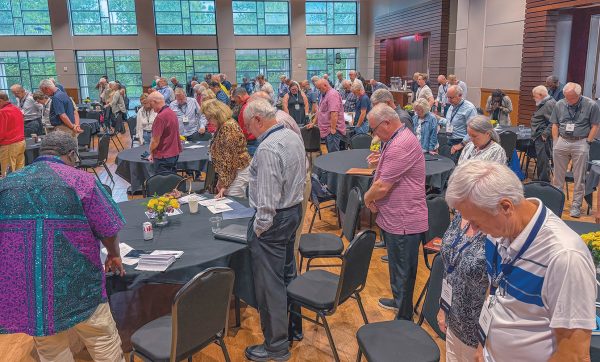
Participants in the Lipscomb Faith and Leadership Forum pray at the two-day event’s conclusion.
Connect’s final day overlapped the first day of the Lipscomb Faith and Leadership Forum. The university’s two-day seminar was an “inaugural gathering of church leaders who are committed to reading the times wisely and responding faithfully,” planners wrote.
The two events seemed to occur in parallel universes, with neither making much mention, if any, of the other. The divide between the two streams represented “is not new but well in place,” said Leonard Allen, dean of Lipscomb’s College of Bible and Ministry.

Leonard Allen
Allen, author of a multi-volume work, “Churches of Christ in the Twentieth Century,” calls the camps “conservative mainstream” and “moderate mainstream” Churches of Christ.
Despite the theological distance, both events had a similar emphasis, Allen said.
“With truth becoming loose and malleable in our time, we need more focus on the essentials of the faith,” he said. “This was a key theme at the Forum.”
The main divide between the two groups: What qualifies as essential?
What draws Tonja McRady to Connect year after year?
“I love the sound preaching,” she replied.
The phrase recalls 2 Timothy 4, when the apostle Paul warns his young protege that “the time will come when people will not put up with sound doctrine.”
What does “sound preaching” mean to McRady?

Tonja McRady, left, and her daughter, Rebekha McRady, speak with The Christian Chronicle after a session on “Natural Conversations About Faith” by Matthew Morine.
“All it means to me is that it comes from the Bible,” she said. “Are you preaching from the whole Bible, the whole counsel of God?”
Attendees represented more than 300 congregations, said organizer Alan Stephens, who works with HomeMission, a ministry for struggling churches. Stephens founded Connect with Phil Sanders, host of the TV show “In Search of the Lord’s Way.” They were inspired by the Tulsa Workshop, which ended in 2017, and similar evangelism programs.
“I personally don’t use the word ‘sound’ to describe our conference,” Stephens told the Chronicle. “I prefer the word ‘biblical.’ It’s not us vs. them. When you follow a biblical approach, your beliefs will match up with the Scriptures.”

Alan Stephens, center, stands alongside fellow Connect Conference organizers.
A record-breaking crowd of 1,322 attended Connect’s first night, as Jesse Eaton of the Stantonville Church of Christ in Tennessee led hymns including “Soldiers of Christ, Arise!” T.J. Kirk, vice president for student services at Freed-Hardeman University and preacher for the Campbell Street Church of Christ in Jackson, Tenn., spoke about the need for Christians to take on the characteristics of Jesus.
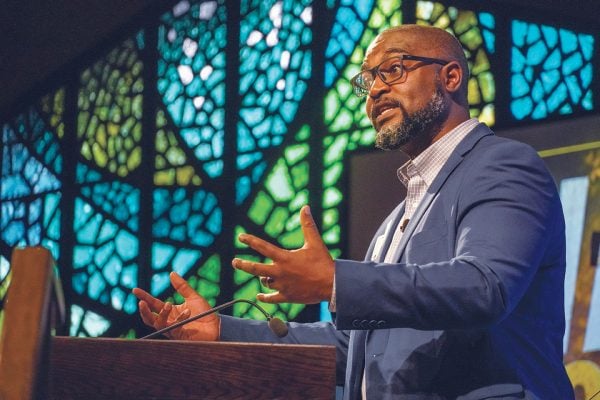
T.J. Kirk speaks on “Walking Worthy: A Shared Calling” at the Connect Conference
Freed-Hardeman, a Henderson, Tenn., university associated with Churches of Christ, hosted a reception for alumni and friends featuring its new president, Keith Harris.
Related: The ties that bind universities to Churches of Christ
Connect’s second night coincided with a summer youth series and featured a sermon by Matt Miller, preaching minister for the Alvaton Church of Christ in Kentucky. Faulkner University, a school in Montgomery, Ala., also associated with the fellowship, hosted a pizza party for the students.
Ministries including World Bible School and Churches of Christ Disaster Relief set up booths in Crieve Hall’s fellowship hall. First-timers Ben and Alanna Griffin manned a booth for Plumline Leadership Institute, a ministry training program based in south Florida.
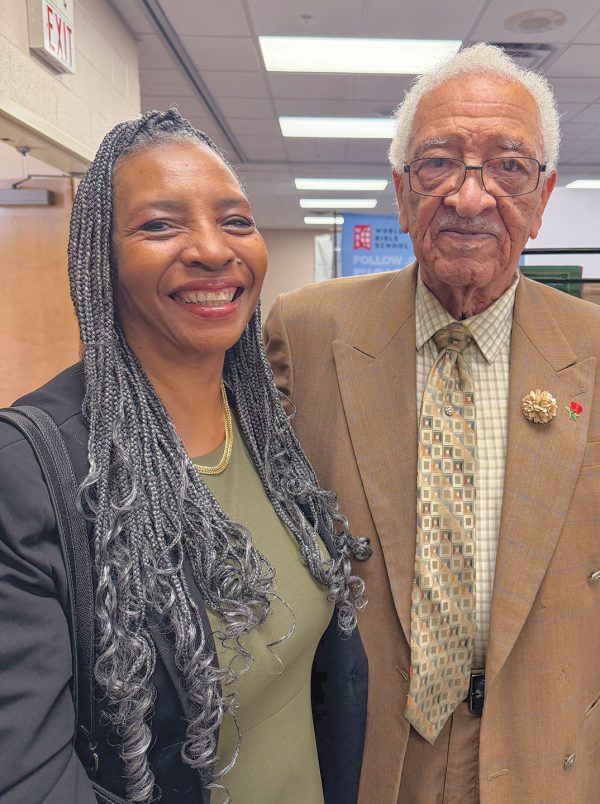
In the exhibitor hall at the Connect Conference, Alanna Griffin stands with her father, Bill Davis, a retired minister who recently turned 91.
“There’s so much good information about the church and the world,” Alanna Griffin said. “It’s almost like a boot camp.”
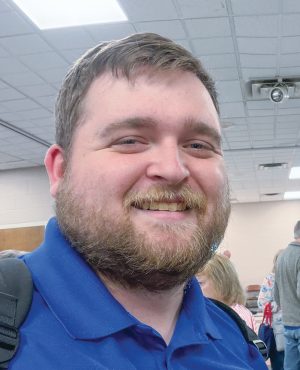
Michael Mullinicks
Michael Mullinicks said he found a session on artificial intelligence particularly enlightening. When asked what “sound doctrine” means to him, the associate minister for the Leoma Church of Christ in Tennessee said, “We’re going to teach what the Bible teaches, and past that, we’re going to leave it there — even with AI, you know. AI is not necessarily a biblical principle, but we can find ways to use it for the glory of God.”
Austin Eddy and his father, Ryan, worship with a 60-member Church of Christ in New Madrid, Mo. Connect gave them the chance to do just that — connect with friends old and new and “join together to learn about God’s Word through different perspectives while still pursuing the truth,” Austin Eddy said.
It’s sad, he said, that the qualifier “sound” must be used when describing congregations. To him, “a sound congregation would be one that follows the Bible,” stressing “the necessity of baptism and … proper biblical leadership.”

Austin Eddy, left, and his father, Ryan at the Connect Conference. In addition to song leading, Austin Eddy composes original hymns.
But that doesn’t mean that churches must be identical, said the younger Eddy, who’s completing a degree at Freed-Hardeman in political science and music: “That’s why God set it up in his plan that each one is autonomous.”
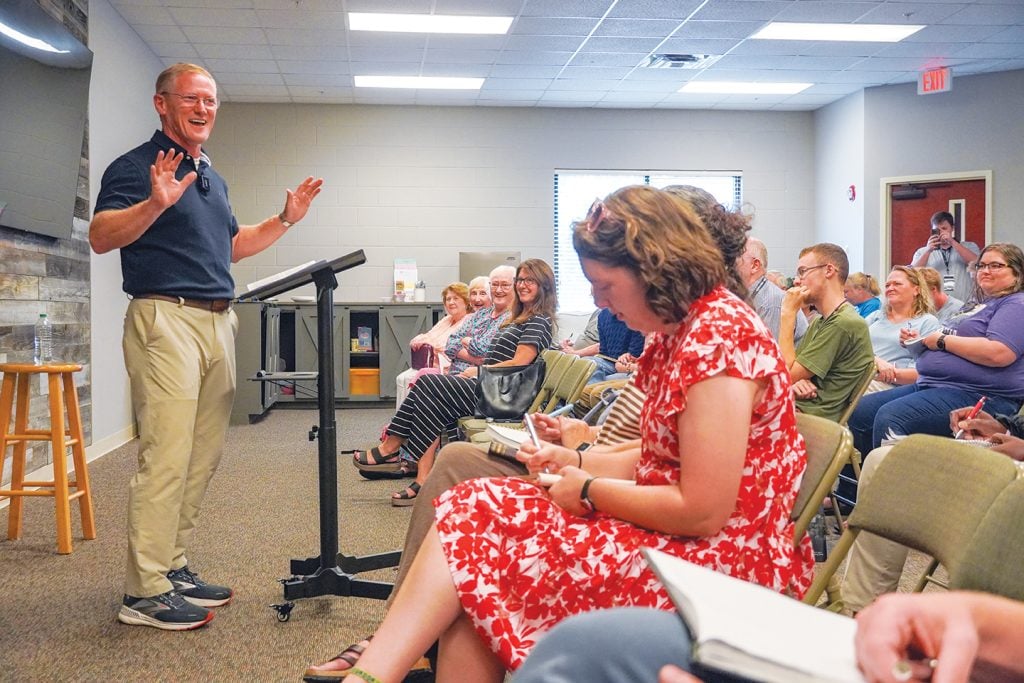
McRady, a Crieve Hall member, spoke in the building’s chapel as part of a track for women only. Men weren’t allowed, but organizers later posted the classes on the conference’s YouTube channel.
In her talk, “The Master’s Symphony,” McRady compared the church to the instruments in an orchestra. They sound discordant as they tune up, until a single oboe plays an A note, and the other instruments produce the note in unison.
But “unison isn’t unity,” McRady said. “If I walk into a room, and everybody has on this dress, and everybody’s hair looks like mine, and everybody sounds like me, we call that creepy. … And yet, so often, we act like unison is the goal in the church.”
To create a beautiful symphony, different instruments must perform under a single conductor, McRady said, citing Paul’s words in Ephesians 4:4-5: “There is one body and one Spirit, just as you were called to one hope when you were called; one Lord, one faith, one baptism.”
“One Lord, Faith, Baptism” was Connect’s theme.
During afternoon classes, Hiram Kemp explored each of those “ones.”
One faith? Kemp, a minister for the Cumberland Terrace Church of Christ in Bowling Green, Ky., cited research estimating the number of Christian denominations worldwide at close to 45,000.
That’s 45,000 groups “all claiming the Bible is the inspired word of God,” Kemp said, “all claiming to be right about their beliefs, their doctrine and practices with divergent worship styles, church organization and various plans of salvation.”
The first Christians also encountered religious pluralism, Kemp said.
“Maybe you might be tempted, and maybe first century … readers were tempted to say in response to Paul, ‘Are you sure? I mean, all of our friends and neighbors believe a variety of things, and I mean, they’re good and honest people.’”
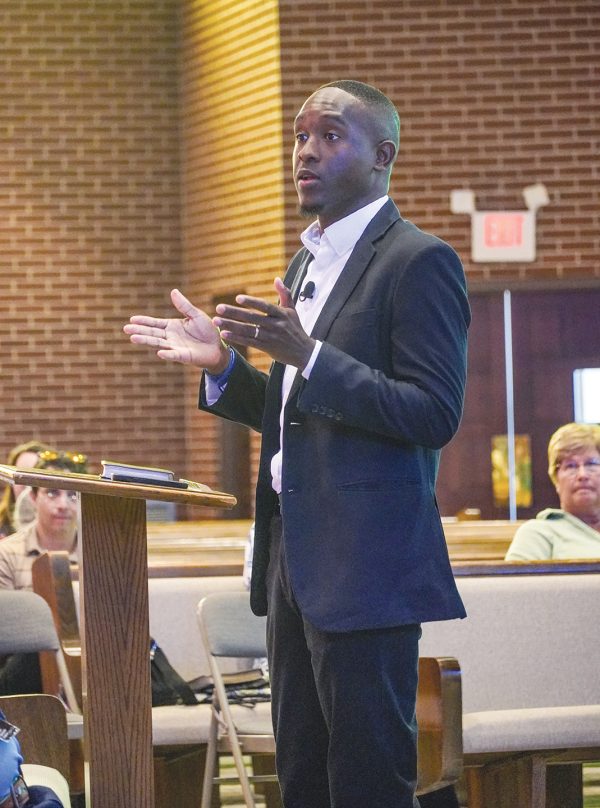
Hiram Kemp teaches a class on “One Lord” at the Connect Conference.
To these objections, Kemp repeatedly quoted Paul: “One Lord, one faith, one baptism.” Later he cited Peter’s words to the Pentecost crowds in Acts 2:38, “Repent and be baptized, every one of you, in the name of Jesus Christ for the forgiveness of your sins.”
“Is that true for everybody everywhere?” Kemp asked. “Is that just, sort of, Church of Christ doctrine? There’s one faith. How do you know that? It’s passed down through Scripture.
“What if we just settle on going with what God says, God’s way?”
“And what about worship? How should we worship? Well, God says he wants people to worship Him in spirit and in truth (John 4:23-24). He’s looking for people to worship him that way. Somebody says, ‘We’ve got traditional and contemporary.’ What about scriptural? What if we just settle on going with what God says, God’s way? God doesn’t want our creativity. He wants our compliance. It’s been revealed to us in Scripture.”
By comparison, the two-day Lipscomb forum was a smaller gathering designed for ministers and church leaders, who paid a fee to cover meals and materials. About 160 participants, representing Churches of Christ and other faith groups, attended classes taught by Lipscomb Bible professors on topics including faith and politics, church history, ministry burnout and discipleship in a digitally saturated world.

Garrett Best prays at the Lipscomb Faith and Leadership Forum.
“We realize that it is important for us in these days of great change, of so much anxiety around us, that we call people together,” said Garrett Best, director of Lipscomb’s Hazelip School of Theology. “You’re doing the work of the kingdom of God.”
Spiritual revivals like the 2023 “Asbury Outpouring” on a small campus in Kentucky give some believers hope for the future, Allen said in a keynote titled “Reading the Restlessness: Discerning the Moment Before Us.” But the Lipscomb Bible dean also cited studies that estimate that 40 million Americans have left the faith in the past quarter-century.
“Is America standing on the edge of spiritual renewal, or are we witnessing the continuing, steady decline of Christian faith in America? The old patterns are no longer stable. New patterns have not yet emerged. It seems there is energy but also confusion all around.”
“Is America standing on the edge of spiritual renewal, or are we witnessing the continuing, steady decline of Christian faith in America?” Allen asked. “The old patterns are no longer stable. New patterns have not yet emerged. It seems there is energy but also confusion all around. Many churches are asking, ‘Where are we? What is God doing in this cultural moment, and how do we lead faithfully?’”

Earl Lavender
Despite the decline in organized religion, America has lots of spiritual seekers, especially young people, said Earl Lavender, Bible professor and executive director of Lipscomb’s Center for Vocational Discovery. Drawing on his experience as a missionary in Italy, he discussed the need for church leaders to understand the “why” behind the events they organize, building meaningful relationships and practicing “radical hospitality.”
John Lancaster said he found the speakers’ messages refreshing. Living in a culture where church attendance is no longer an assumption, “that could be a gift,” he said, adding that Christians should respond by “returning to the roots of just living out the faith.”

John Lancaster
Lancaster grew up in Montevideo, Uruguay, where his parents were Free Will Baptist missionaries. Now he teaches elementary school Spanish and is earning a Doctor of Education degree from Lipscomb. He and his family worship with The Gospel Church, a Nashville congregation that partners with Southern Baptists and The Gospel Coalition.
Growing up in South America gave him a global perspective on the divisions among followers of Jesus, he said.
“Our faith is not in our denomination,” Lancaster said. “It’s in Christ. It doesn’t matter, the label on the bottle, as much as what’s inside the bottle.”
Like Connect, Lipscomb also had a class on AI. Roland Gbamis attended the forum and said that the diversity of “topics that affect the body of Christ” attracted him.
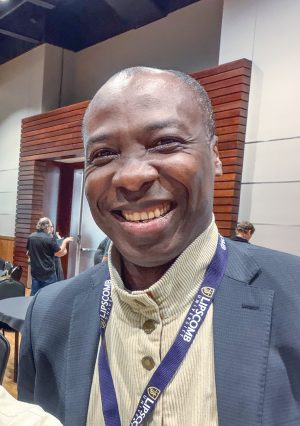
Roland Gbamis
Gbamis grew up in Nigeria in a non-instutional Church of Christ and moved to Canada to pursue a doctorate in public health at the University of Toronto. Now he travels between North America and his homeland, ministering in both.
“I didn’t come here for all of those appellates,” he said when asked about the divisions that exist among Churches of Christ. “I came here because I felt there is something God is calling me for.”
Among the souls he’s encountered at Lipscomb, regardless of race or nationality, “I see people with the fear of God. When I look at many of them, how they talk, their life convinces me that, truly, they are living as children of God. … I don’t feel as if I’m different from any of them. Why? Because they treat me as a child of God.”
Both Connect and the Lipscomb forum ended with discussions of unity among believers.
Christians should be eager to pursue this unity, Matt Cook said in Connect’s closing keynote.
In Ephesians 4, before stating that there is “one Lord, one faith, one baptism,” Paul urges Jesus followers to “bear with one another in love” through the bond of peace, the Freed-Hardeman associate professor of Bible noted.
“Unity without truth is just togetherness,” Cook said, but “just because it’s different doesn’t mean it’s wrong. … Unity must be grounded in truth, but we must not elevate our opinions and ideas to the level of that truth or we’ll find division.”

Carlus Gupton
Less than 24 hours later, Carlus Gupton closed Lipscomb’s forum by calling for Holy Spirit-formed leadership that is calm, steady and deeply rooted in Christ. The Lipscomb Bible professor referenced another passage from Paul, Philippians 4, in which the apostle urges his fellow believers to help Euodia and Syntyche, two Christian women in disagreement, “to be of the same mind in the Lord.”
“He’s calling Euodia and Syntyche and the people who are around them to a higher sense of behavior,” Gupton said. “That’s especially hard when you experience things in church that you don’t like, and you have people pulling on you.”
After the forum, Gupton told the Chronicle he sees Churches of Christ as “an extended family.” Although members “sometimes see important matters quite differently … they remain bound by a shared history and an identity.”
Cook also noted that “sound,” “progressive” and other labels “don’t always capture the complexity of where people and churches actually stand.”
“While I think the institutional and relational distance between some parts of our fellowship has widened, I would hesitate to describe it as one clean split or to divide everyone into two clearly defined camps,” Cook told the Chronicle. “Connect and the Lipscomb forum reflect some of those differences, but neither event perfectly represents one side or the other.”
At the same time, he said, both events “reveal shared concerns about discipleship, faithful leadership and the future of the church.”

Matt Cook speaks about unity as the Connect Conference closes.
Gupton emphasized: “The proximity of these two conferences actually gives me more reason for hope than concern. Connect seeks to strengthen Christians in biblical faithfulness, discipleship, evangelism and spiritual growth. The Faith and Leadership Forum seeks to equip church leaders for faithful, discerning leadership in a changing culture.”
Participants at the two gatherings “would certainly disagree on certain matters,” Gupton said. “But these are noble, good efforts, and there is so much in them that Christians on both sides can genuinely affirm.
“I would much rather see the 4 miles between our locations as a bridge to cross rather than a boundary to defend.”
ERIK TRYGGESTAD is President and CEO of The Christian Chronicle. Contact [email protected].
From Florida College in Temple Terrace, Fla., to Pepperdine University…

ATLANTA — Hundreds of Christians came to Atlanta seeking true…

The parable of the lost sheep wasn’t written about church…

LITTLE ROCK, ARK. — The vision for ReMission started small.…
Conservative mainstream. Moderate mainstream. Non-institutional. Non-Sunday school. Progressive. Instrumental. One…
The church in America is shrinking. The number of men,…
Your donation helps us not only keep our quality of journalism high, but helps us continue to reach more people in the Churches of Christ community.
