
 Tennessee


Artificial intelligence, authentic faith
TUSCALOOSA, ALA. — From theological research to Scripture translation to…

|
Getting your Trinity Audio player ready...
|
I caught up via Zoom this week with Wes Woodell, a Tennessee-based ministry technology strategist who founded Connect My Church.
I wanted to talk about artificial intelligence.
“Is AI going to kill us all?” I asked, pointing to recent news coverage of that possibility.
Related: Artificial intelligence, authentic faith
I’ll share Woodell’s response in a moment. But first, a bit of background: The 46-year-old cybermissionary first developed a love for technology while watching “Star Trek” as a child.
He’s pursuing a Ph.D. in intercultural studies through the Talbot School of Theology at Biola University. Through that program and a website he launched called Ask Bible Questions, he’s working to develop AI tools to advance the spread of Christianity globally.
Ministries such as Sunset International Bible Institute in Lubbock, Texas, have used solar players — handheld, sun-powered audio devices — to take the Bible to remote places.
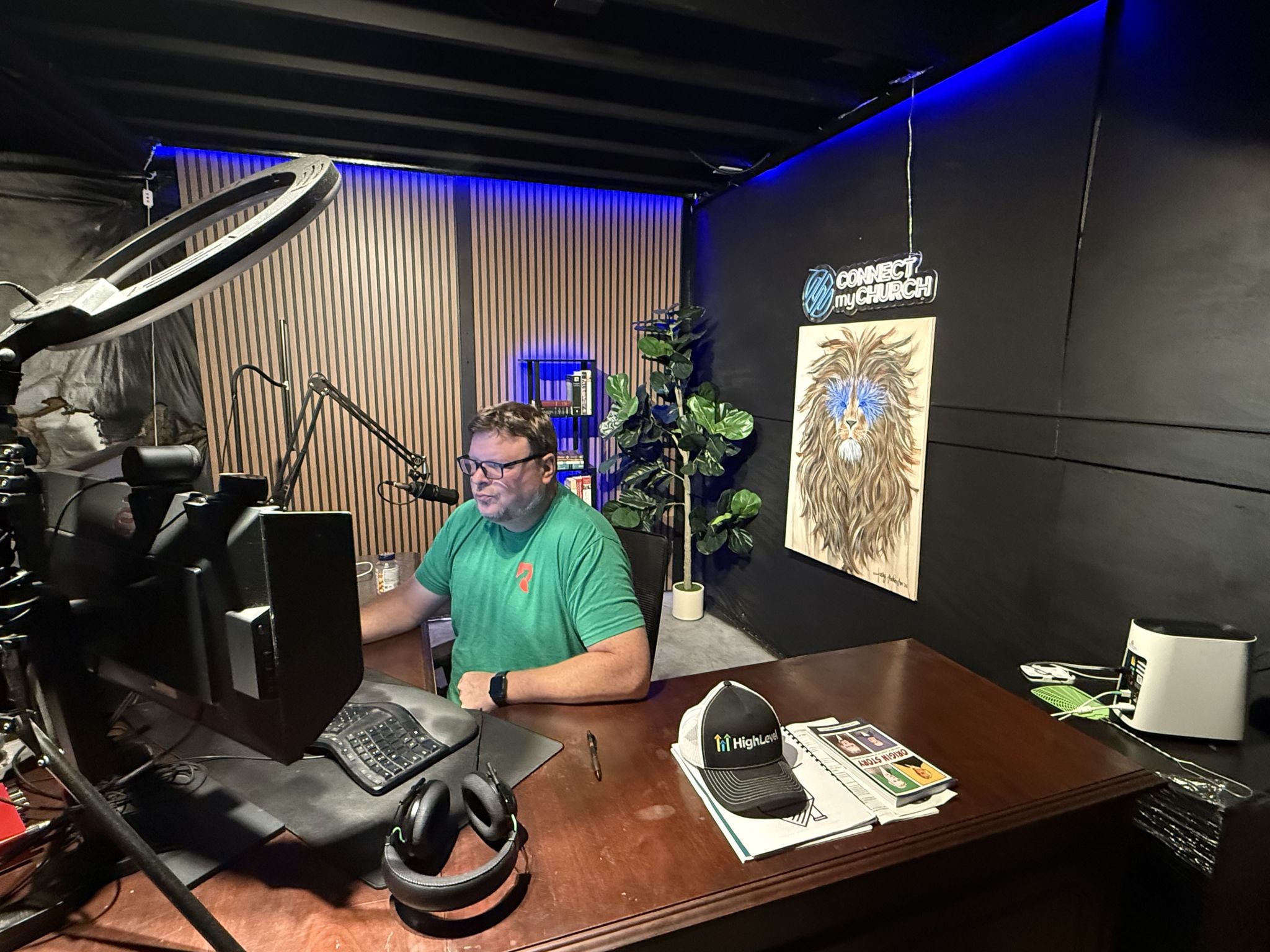
Wes Woodell is a ministry technology strategist based in Columbia, Tenn.
“So my question is, what if we could put something out like that which didn’t just play a recording?” said Woodell, who lives in Columbia, 45 miles south of Nashville. “What if you could actually ask it questions, and it would give you answers? … You know, it’s not the open internet. It’s just an enclosed set of resources that we can put on there, and that’s essentially what we’re building.”
Woodell’s work — in cooperation with the Renew.org Network — to create such tools intrigues me.
But given his expertise, I felt compelled to inquire, too, about more general AI matters.
Related: Christians use AI to share Jesus
Life-and-death matters, you might say.
So I asked about AI killing us.
Woodell, a 2008 Bible graduate of Harding University, smiled at the question. He didn’t seem overly concerned. Then again, he didn’t dismiss the premise entirely.
“There’s a lot of people afraid of that, and there are some real destructive capabilities when you think about security, when you think about where we’re going in the future with new technology,” said Woodell, who earned a Master of Arts in Theology degree from Fuller Seminary in 2013.
“For instance, humanoid robots,” he added. “If those things are deployed and successful, and now there are a million humanoid robots in 10 or 15 years, or maybe even sooner than that, what if something could hack all of those things at the same time?” he added. “What if a foreign, hostile government could take over those things and make them start karate-chopping people and kicking people in the head?”
I missed the examples he gave after that because I was busy trying to think of a place to hide. That’s dark humor, by the way, because my AI program transcribed every word.
But Woodell was just pointing out, he explained, that “the caution and the fear are not completely unfounded.”
He didn’t mean to be a doomsayer.
“What you also have to think about is, there are people using the same tools — advanced tools for defense and for securing systems and for keeping people out — that are employed, too,” he said. “And so, I think, in terms of our national security, it’s important that we stay at the forefront. This is way more important than the space race was in terms of security.”
My next question moved from the physical to the spiritual.
Related: Scholars ask, ‘What will be our future?’
After reading a recent piece by John Mac Ghlionn at Religion Unplugged — headlined “AI might be conscious. If so, God help us” — I was curious about Woodell’s take.
“Does AI have a soul?” I asked.
“I don’t think it can,” he replied. “This idea of supreme intelligence, I think, is a misnomer. When we’re talking about AI, we’re talking about a complex math equation. It doesn’t process thought. It doesn’t think. It processes. It’s a computer program.”
That said, Woodell acknowledged that not everyone would agree with him.
“There are people in Silicon Valley who are not believers in God,” he said. “They believe they can create God. They’re humanists, and they believe in something called transhumanism. They believe the best contribution they could make to the world is to advance technology to the point where humans could merge their consciousness with a machine, thereby living forever. They want to achieve immortality.”
Full confession: I Googled “transhumanism” and got an AI overview of it.

Wes Woodell and Bobby Ross Jr. meet via Zoom to discuss artificial intelligence.
Woodell kept talking, offering more insight than I have space to share.
In response, I replied simply, “That’s fascinating.”
And I meant it.
Related: In North Korea, the Gospel’s in the air
Woodell wrote an article for the Christian Standard, an independent Christian Churches publication where he serves as digital strategist, on how believers can use AI to expand their reach. I first interviewed him in 2009 during his time as a Church of Christ campus minister at San Francisco State Uiversity.
Before our conversation ended this week, I asked Woodell to offer advice on how churches can use AI to help fulfill their missions.
“Right now, there are certain busy work tasks that AI could really help with,” said Woodell, who attends the Harpeth Christian Church in the Nashville suburb of Franklin. “For example, I’m developing a tool … for churches to get their sermons online and get all of that search engine optimized on their website, so that they can use their sermon content to connect with their local community in online searches. That’s something that AI can greatly simplify.”
On the administrative side, AI can help with tasks such as scheduling, social media posts, bulletin work and letter drafting.
“What frightens me a little bit are preachers using AI to write their sermons for them,” Woodell said. “That has become a thing, and I don’t think that’s healthy.
“AI can help give some feedback that’s helpful sometimes,” he added. “But I would not have it just draft the sermon for you. I think that’s very dangerous and also just not good for a preacher’s heart.”
Just this week, the evangelical research organization Barna Group posted an article asking, “In a crisis, should AI hand off to a human?”
You don’t have to consult a chatbot to know such questions seem likely to remain timely.
BOBBY ROSS JR. is Editor-in-Chief of The Christian Chronicle. Ross writes the Weekend Plug-in column for Religion Unplugged, where this piece originally appeared. Reach him at [email protected].
TUSCALOOSA, ALA. — From theological research to Scripture translation to…

Missionary Leslie Taylor preaches in English and Japanese each Sunday…

Houston — ‘Welcome to Hogwarts!” John Barton said with a…

GIMPO, SOUTH KOREA — North Korea is right there. Standing…

FAIRFAX, Va. — It’s just before 1 p.m. on the…

OKLAHOMA CITY — It’s a call you never want to…
Your donation helps us not only keep our quality of journalism high, but helps us continue to reach more people in the Churches of Christ community.
